My relationship with running goes back 20 years, and my younger sister Nicole is the original inspiration behind it. She’s my best friend, my business partner, my coach…my girl. In high school, we ran cross country and track together. In college, I went on to run at the club level, and she ran D1 at a university. Once I graduated college, we both kept racing, and I started chasing the goal of running a marathon in all 50 states—a quest my dad completed in 2019.
I was never super serious about my marathon finish times and just wanted to do my best in each race. But when I watched Nicole crush the Boston Marathon through stormy conditions in 2018—the same year Des Linden (my hero!) won—that changed. Although I’d completed 10 marathons already, none had been part of the Abbott World Marathon Majors, and the Boston Marathon especially felt so far out of reach. Its notoriously fast qualifying time left very little margin for error and makes earning a spot feel especially hard-earned. I was about an hour away from making the cut, but witnessing everyone push through the discomfort of the terrible weather in such an exciting city inspired me to try.
Nicole began training me, and as we traveled around the country meeting other runners and doing marathons, I started falling in love with running even more. Four years later, Nicole and I finally ran the Boston Marathon, and I cried many happy tears since it was a long road to qualify and actually run it. Plus, I was 32, and my husband and I wanted kids—but we’d put off trying while I was training for these races, and there was just a lot going on in our lives at that time. We figured we'd start a family whenever the time was right, sometime in the future.
A few months later, I ran my first marathon while pregnant—but I didn’t know it.
Everything was going great until the last couple of miles, when I thought, “Something feels really off.” Usually I have an iron stomach, but that day, I had total GI distress—and I was disappointed in my performance. Two weeks later, I was feeling nauseous all the time; that’s when I found out I’d run the marathon three weeks pregnant.

At that point, I had already committed to pacing a local marathon later in the year, and I seriously considered not running it. I was comfortable with the marathon distance, but had never run while pregnant before, so it was a whole new territory of unknowns, and I was scared.
Fortunately, I had a fantastic medical team that encouraged me to still run it, especially because I had already been running long distances pre-pregnancy. Their rule of thumb was to do “nothing new” during the pregnancy that I hadn’t already done, and to keep the effort at or below what my body was accustomed to.
My mom’s generation was encouraged to chill out, lay low, and put their feet up during pregnancy. But now, there’s growing evidence that if women have been exercising prior to pregnancy and are still able to, it could help them have a healthy pregnancy and a smooth labor and delivery. It could even help decrease postpartum recovery time and improve mental health during the “fourth trimester” (the 12 weeks after giving birth), making it easier to move through life with your newborn. Always consult your doctor to make decisions around exercise and pregnancy that are right for you.
Pregnancy taught me to prioritize how I felt in the moment instead of sticking to a rigid plan.
Pre-pregnancy, I thrived on schedules, rarely missed runs, and lived for the thrill of challenging workouts, chasing splits, crushing intervals, and weekend long runs. But throughout the rest of my first trimester, I struggled with exhaustion, nausea, and a body that felt unfamiliar almost overnight. As a result, I had to adjust my training to prioritize how I felt day to day rather than sticking rigidly to a plan like I had before.
As I trained with Nicole, we worked on striking a balance between running for performance and purely for joy—and that mindset shift was key. I focused on sleep, stretching and mobility work, cross-training, and even yoga several days a week. I shifted between running, run-walks, walking, and rest depending on how I felt, and took more rest days.

I also sought out nutrition guidance from a registered dietitian and sports nutritionist to make sure I wasn’t underfueling myself, especially since I’d lost my appetite at certain times during pregnancy. I began waking up and having a “first breakfast,” doing my workout, then having a “second breakfast.” Eating five, six, or seven small meals a day kept my nutrition consistent even when I didn’t feel like eating. Liquids like smoothies with milk for protein, calcium, and bone support, Go Go Squeezes, and Skratch Labs (a brand I work with) also became an easy way to get calories in, especially in the morning or on the go. As a result, I never felt tired or fatigued during training—I always felt good.


Skratch Labs Fruit Punch Hydration Sport Drink Mix
I ran the local marathon at 17 weeks pregnant (my second trimester), and it ended up being a total joyride.
Carrying my baby while helping others cross their own finish lines felt incredibly powerful, and the race affirmed what I already knew: I had prepared for this. I was fueling my body and my baby with intention, and I could keep doing it.
My second trimester marathon felt so smooth that I decided to do one more marathon in my third trimester. As my body changed and prepared for birth, it felt like every workout required more effort. I started wearing a belly band to relieve the increasing pelvic pressure, my pace slowed, and my desire to push harder dwindled.

So, when I completed the third marathon at 33 weeks, I wasn’t going for time and I wasn’t pacing or racing—I just wanted to finish. I ran slowly and even began run-walking at mile 18 with my husband and dog.
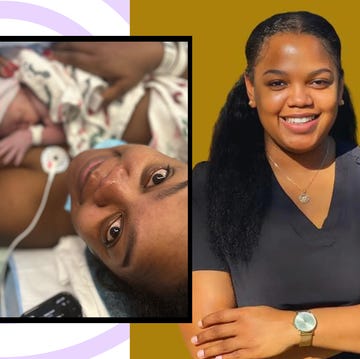
I continued running until my first child was born on April 8, 2023. After I had my daughter, I ran a few half-marathons followed by the Every Woman’s Marathon in November 2024, with Nicole. My daughter, who was a year and a half old at the time, also joined me for a bit of it in her stroller, and it was so cool to have her experience that.
Fast forward to January 2025: I paced another marathon, then found out I was pregnant with baby number two.
Learning I was pregnant again reignited the idea of running a race in each trimester—this time with more confidence, perspective, and intention.
I had already proved to myself I could do it, and although I didn’t need to do it again, it didn’t make sense not to run. So, I completed another marathon in my second trimester followed by a 24-hour bike-run-walk in my third, which I completed to marathon distance—I was especially proud of that achievement.
Pregnancy helped me loosen my grip on control, give myself grace, and stop measuring success by completed workouts or time goals. This season of pregnancy was about learning how I can be the best version of myself for my daughter, and learning to let go of perfection. I learned to be okay with the experience being different than what I initially set out for it to be.
Running when I wasn’t pregnant invited me to dig deep, push limits, and chase what was possible. Running while pregnant asked me to tune in to my body, to my baby, and to the moment I was in. Instead of pushing for PRs, it asked me to get curious: What does this run feel like today? What does my body need right now?
What surprised me the most was how closely pregnancy (especially birth) mirrors marathoning.
You can’t skip to the end. You have to stay present in the mile or contraction you’re in, get comfortable with discomfort, and trust that just when you think you can’t do it anymore, you reach the finish line—this time with a baby in your arms.
I was fortunate to not receive much direct criticism about my choice to continue moving my body during pregnancy. My loved ones and close friends were supportive—although some people in my parents’ generation had safety concerns—and I was intentional about not sharing widely on social media at first. I wanted to protect my peace and focus on my body, baby, and medical guidance, not outside noise.

When I did get questions from people, they were mostly out of curiosity, not judgment, like, “Why?” or “How are you doing this?” What I heard most often was intrigue from other women—especially those who, like me, felt uncertain or fearful about how pregnancy might change their bodies or ability to run. I always tried to answer questions with openness and education, especially because there’s still so much misinformation about exercise and pregnancy, but the field is definitely still advancing.
I always reminded myself that no one else was in my body, and no one knows me like I do. Pregnancy didn’t take away my strength; it asked me to redefine it. It’s been exciting to give women the courage and hope that life doesn’t end when you become a mom. You don’t have to put aside your goals just because you choose to start a family. You can take them along for the journey. It doesn’t have to be a marathon—it can be everyday movement.
My second daughter, Stella, was born October 19, 2025. Nowadays, my bandwidth for running is much more limited with two kids. I often get asked, “When are you coming back to marathon training?” In my view, it’s not so much “coming back” as it is “stepping forward.” This is the language I think about when it comes to motherhood. You’re changed in the coolest, most beautiful way. You’re not “bouncing back” to who you were—you’re stepping forward.
Tianna is the former associate health and wellness editor at Women’s Health. Her writing on wellness and relationships has been featured in Cosmopolitan, Elite Daily, Glamour, mindbodygreen, and more. She holds a M.A. in clinical psychology in education from Columbia University and is a certified yoga instructor. When she’s not writing, you can find her traveling, trying new workout classes, and speaking with audiences about mental health.